
The Six Layers of Learning
What works beneath the surface of mathematics
Content of this page
- The Six Layers of Learning
- Mathematics as a rewarding playing field
- What the self-regulatory instance «integrity buffer» has to deliver
- The framework: Julius Kuhl's PSI theory and Maja Storch's Zurich Resource Model
- The six layers
- 1. Personality — who this child is
- 2. Interest — what this child is drawn to
- 3. Attention and executive functions — how this child steers themselves
- 4. Motivation — why this child wants something, or doesn't
- 5. Volition — why this child stays with it
- 6. Competence and flow — when this child knows that they can
- How the layers serve the integrity buffer
- What this means in the lesson
- What comes in the next part
- Möchten Sie mehr erfahren?
When self-regulation works, you see it last in the result. What does the work beforehand is six psychological layers — and a theoretical framework that shows how they interact.
Link to the first article «The Invisible Variable»
In the first article of this series, I named the variable that good mathematics tutoring really works on — the fit between the child as a person, the task as a demand, and the relationship between child and tutor. I described this fit as a process that is established self-regulatively within the child or adolescent through the so-called «integrity buffer», and steered responsibly by the tutor in light of the child’s individuality. The «integrity buffer» that the child draws on is their self-regulatory instance — the inner room for manoeuvre that helps them cope with outer demands and inner ones such as emotions or anxieties.
The «integrity buffer» is not a structure you can locate in the brain. It is my working tool — a way to guide my work in performance-oriented mathematics tutoring as well as I can. My goal is for another person to be able to assimilate new knowledge and, ideally, to accommodate it — meaning, in the sense of the educationalist Jean Piaget, to build new cognitive schemas.
If the integrity buffer is supposed to be a self-regulatory instance, then in this article I would like to show its dimensions, processes and effects with the help of existing models and theories.
Mathematics as a rewarding playing field
As a career counsellor, coach and tutor, I see psychology — essentially the science of human experience and behaviour — as a valuable tool for describing and guiding people’s efforts to adapt. The demand placed on pupils to perform well in mathematics serves me as a clear «playing field» for this work.
Mathematics is measurable in a hard sense: a problem is either solved or it isn’t. A required grade is either reached or missing. This feedback shows whether the knowledge to be conveyed has actually reached the child or adolescent, given their particular dispositions and the approach we used.
Every school subject is a special reflection of our environment. Fundamentally, in every subject pupils are dealing with demands they have to cope with. So when, in the following sections, I explore the dimensions, processes and effects of the integrity buffer in performance-oriented mathematics tutoring, I see this as representative of many demands our environment places on us.
In this «model-building», please don’t see me as a super-theorist, but rather as a «cook» (I love cooking, by the way), who selects fitting ingredients for a menu and then writes down the recipe. In philosophy-of-science terms this corresponds to «grounded theory», where approaches emerge from practice in order to reflect on one’s own work.
What the self-regulatory instance «integrity buffer» has to deliver
In the first article on the integrity buffer as the «invisible variable», I presented fit-evaluation and meaning-evaluation as its key self-regulatory elements. Under shifting conditions, this self-regulatory instance has to perform two checks:
First, it checks fit: Do I have what it takes — dispositions, energies, interests, competencies — to cope with the demand at hand? In school or work situations, the fit-evaluation generates corresponding feedback. This approach shapes the career support I offer under PONTES.
Second, it checks coherence: Does what I am doing make sense to me? This meaning-evaluation is the central approach of the coaching I offer under FONTES. But this aspect also matters in MONTES (the maths tutoring), in motivational terms: it reaches the child or adolescent with the question, why should I engage at all in performance-oriented mathematics tutoring?
For me, then, the self-regulatory instance «integrity buffer» draws its driving impulses from fit- and meaning-evaluation. But this instance only becomes load-bearing through psychological resources: through dispositions, drives and self-steering capacities that a person can fall back on. In what follows, I draw on resources that have been formulated in psychological research, and I have arranged them in six layers. I also show how they come into play in my tutoring.
The framework: Julius Kuhl’s PSI theory and Maja Storch’s Zurich Resource Model
Self-regulation does not emerge from a single trait such as conscientiousness, intelligence or willpower. It emerges where various inner forces work well together: thinking, feeling, bodily sensation, motivation and action-control.
For this understanding I draw in particular on two psychological models: the PSI theory by Julius Kuhl and the Zurich Resource Model by Maja Storch and Frank Krause. Both show that self-regulation is more than just «pulling yourself together».
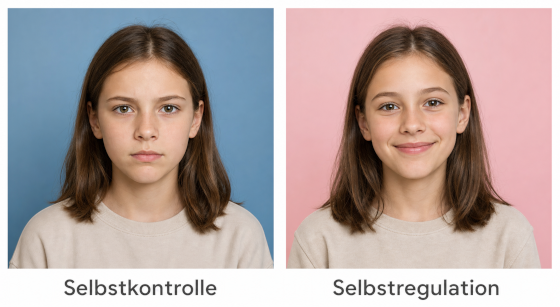
Kuhl distinguishes between self-control and self-regulation. Self-control, in his view, means that a child can deliberately meet demands even when there is little inner agreement with the specific goal. This can work in the short term but it is draining. Self-regulation, by contrast, goes deeper: the child finds an inner connection to what he or she is supposed to do. The child is able to link personal needs, feelings and goals with the task. In this way, not only performance arises, but also sustainable motivation.
The Zurich Resource Model complements this idea in a practical way. It shows how people, through inner images, bodily sensations and supportive guiding statements, gain access to their own resources. It is not only the head that decides whether something feels right; often the body, too, signals whether a direction will carry us or not.
Both models make one thing clear: children do not learn better when they are simply pushed. They learn more sustainably when they are inwardly involved. This is precisely where the integrity buffer comes in. It helps to recognise which resources a child needs so that they don’t merely function, but can regulate themselves in a way that is both effective and coherent.
This understanding supports me in lessons and in accompanying children and adolescents. It also helps in conversations with parents: we ask not only why a child can’t manage something, but what kind of inner support they are missing in order to become capable of acting.
The six layers
In what follows, I do not treat them as equal modules, but in a sequence that follows an inner movement. It begins with what is least changeable — personality — and ends with what is most visible: competence. Between them lie the layers I work on as a tutor.
1. Personality — who this child is
Every child brings their own personality. Psychology often describes such differences with the so-called Big Five: openness, conscientiousness, extraversion, agreeableness and emotional stability. This model is well-researched and shows: personality does not explain everything, but it does help to understand how a child learns, reacts and deals with demands.
This becomes visible particularly in the maths lesson. A very conscientious child likes working step by step and becomes uneasy when asked to explore too freely. A very open child, on the other hand, enjoys discovering exciting connections freely, but sometimes loses sight of the goal. Such a child needs clear frames so that their curiosity gets direction. A very agreeable child tends to say «yes, got it» too quickly, even when much is still unclear — not because they are pretending, but because they don’t want to strain the relationship. With such a child I often need to point out that they don’t have to keep asking my explicit permission to say «no, not yet».
Good support therefore does not try to change a child’s personality; it adjusts the demands so that the child does not have to work against themselves. In this kind of atmosphere, real learning awakens — learning in the child’s or adolescent’s own sense.
2. Interest — what this child is drawn to
While personality describes how a child fundamentally reacts, interest shows where they orient themselves inwardly. Some children want to understand and investigate; others want to apply things practically, design, explain, lead, or work within clear structures. Such directions of interest are described, among other places, in the RIASEC model by John L. Holland, which is also used in career counselling.
In mathematics, the same task can feel quite different to different children. For an investigative child, an equation is a puzzle. For a practically oriented child, it is a tool. For a socially oriented child, it becomes interesting when they can explain it to someone else. For a child who likes order, it provides security when the rule is clear.
Good support takes these differences seriously. The mathematical task stays the same, but the way in changes: through a puzzle, an application, a conversation, or a clear structure. This gives the task a meaning that fits the child.
Interest does not mean that a child should only do what they happen to feel like at the moment. It means finding an inner point of connection so that learning becomes more than duty.
3. Attention and executive functions — how this child steers themselves
Self-regulation also includes the ability to direct one’s own attention and one’s own actions. In psychology this is called executive functions. Three abilities are especially important: holding information in mind, inhibiting impulses, and flexibly switching between different solution paths. These abilities continue to develop into young adulthood.
In mathematics it quickly becomes visible when a child needs support here. A child might forget at the second step what was important in the first. That doesn’t necessarily mean they don’t understand the material; sometimes the working memory is simply overloaded. Another child starts several tasks at the same time without finishing any. Yet another sticks with one solution path even when it doesn’t work.
Such difficulties are often too quickly interpreted as «attention problems». Sometimes that is accurate. Often, though, what the child mainly needs is clearer structure: smaller steps, visible intermediate results, announced transitions, and short breaks so that the mind can clear again.
Good support therefore does not work with appeals like «concentrate better!», but with routines that take the load off. In that way a child can strengthen their self-steering step by step.
4. Motivation — why this child wants something, or doesn’t
After personality, interest and self-steering, we now come to drive. Motivation does not simply mean that a child has to «want it enough». What matters is the distinction between a wish and a genuine inner willing.
Many children wish for good grades, a passed exam, or the recognition of their parents. And yet the step into learning does not always succeed. The child may say «I want to study» — and still not begin. That is not a sign of laziness or weak character. Often the inner mood doesn’t match the task: the thought of mathematics triggers more pressure, resistance or reluctance than confidence.
An appeal like «you just have to push through» usually doesn’t help much in that case. It can work in the short term, but at high cost. What lasts longer is reframing the task in a way that lets the child find a more positive inner access.
Good support therefore asks: what makes this task hard? What could make it easier, more meaningful, more reachable? Sometimes clear small goals, a supportive sentence, a fitting image or a different sequence will help. What is decisive is that a mere «must» can become an own «want» again.
Then the lesson no longer drags the child along. The child can set themselves in motion.
5. Volition — why this child stays with it
Motivation decides whether a child begins. Volition decides whether they keep going when the first enthusiasm fades. That sounds theoretical, but in tutoring it is visible every day: many children start with goodwill. It gets harder when a task turns out to be more demanding than expected.
This is where Julius Kuhl’s distinction between self-control and self-regulation becomes especially important. Self-control means: hold on, grit your teeth, function. That can help in the short term but exhausts you over time. Self-regulation goes deeper: the child stays in contact with themselves, even when things get hard. They don’t lose sight of their needs, feelings and values; they find a way to stay in relationship with the demand.
Kuhl calls this self-motivation capacity: the ability, in a difficult situation, to reconnect inwardly rather than freeze or give up. A child with this capacity can stay engaged without overriding themselves. Without it, they either break off — or they hold out and exhaust themselves doing so.
Good support therefore strengthens not only the goal but also this self-connection. That includes short pauses in which the child notices whether they are still on board; permission to approach a task differently or interrupt it when inner resistance gets too strong; and a brief debrief at the end: what carried me? What cost me energy?
In this way, staying power does not arise from pressure but from coherence. In this sense one can also understand «grit»: not as blind teeth-gritting, but as patient staying-with-it that does not turn the person against themselves.
6. Competence and flow — when this child knows that they can
The last layer is visible where parents, school and exams usually look first: at ability. What is meant is concrete mathematical ability — fractions, equations, probability, geometry. But psychologically, competence is more than a measurable result. It also shows in whether a child experiences: «I can do this.»
Here something becomes important that Mihály Csíkszentmihályi called flow: a state in which task and ability fit each other well. The task is demanding enough to be interesting, but not so hard as to overwhelm. The child is then in the material, not beside themselves. They can read mistakes as hints, not as immediate threats. Time passes differently, and mere work becomes real involvement.
This matches the original meaning of «interest»: inter esse (Latin) means «to be between» or «to be in the middle of». Interest is therefore not just enjoyment, but an inner being-involved with something.
In tutoring, flow is an important signal. When it arises, the previous layers are working well together: personality, interest, self-steering, motivation and volition. When it fails to arise, something is usually blocked somewhere — sometimes the task is too easy or too hard, sometimes the inner connection is missing.
Good support therefore tries to keep adjusting the difficulty of the tasks. Too easy leads to boredom. Too hard leads to pressure. Exactly in between is the zone where learning carries: the child is challenged, but not overwhelmed.
Then mathematics is no longer simply «done». The child experiences that they can — and this experience is often the moment when, from the parents’ perspective, tutoring «finally works».
How the layers serve the integrity buffer
To round off the picture, a brief look back. The integrity buffer performs, as said at the beginning, two functions: the fit-evaluation — «does this suit me?» — and the meaning-fulfilment matrix — «is what I am doing coherent for me?». Both functions cannot work out of nothing. They constantly draw on all six layers, with different weights.
When the fit-evaluation works with the first three layers, it checks what the personality can tolerate, what the interest can hook into, what the self-steering can allow. If the answer is off there, the buffer registers it, and the child experiences what we would describe as «doesn’t fit» — usually long before they can put it into words.
When the meaning-evaluation draws above all on the last three layers, it checks whether motivation is fed from the child’s own self, whether volition is carried by coherence, whether competence in flow comes back as confirmation. This is where it is decided whether a child experiences a task as meaningful or as mere going-through-the-motions.
In practice both axes are always active at once. A child can be stable on the fit axis — the task is age-appropriate, the tutor pleasant, attention is holding — and yet suffer on the meaning axis, because parents are expecting a future that remains foreign to the child. Or the other way round: a child is on fire for a subject but cannot hold the material because of a weak self-steering layer. I see both constellations regularly. Both call for different responses.
This is why working on just one layer is not enough. Self-regulation succeeds in interplay. A blocked layer pulls the others in with it, and the evaluation functions then return a distorted picture. Whoever wants to understand the system has to look at it as a system — and this is the theoretical point of both PSI theory and the Zurich Resource Model.
How the layers serve the integrity buffer — in parents’ terms
With this the picture comes together. The integrity buffer has two central tasks: it checks whether a demand suits the child, and whether what is being done is inwardly coherent. Put simply, it asks: «Does this suit me?» and «Does this make sense to me?»
These two checks do not arise from nothing. They draw on the six layers described above.
When the fit-evaluation works on the first three layers — personality, interest and self-steering — what becomes visible is what a child can tolerate, where they can inwardly hook in, and how much structure they need. If something is off here, the child often experiences very early: «this doesn’t fit» — even if they cannot yet explain why.
When the meaning-fulfilment evaluation works on the last three layers — motivation, volition and competence — what gets decided is whether a child experiences a task as meaningful or merely processes it. Is motivation fed from the child’s own inner side? Can the child stay engaged without overriding themselves? Do they experience in their ability a welcome confirmation: «I really can do this»?
In practice it matters to me, as a tutor, to keep both axes in view. A child can manage well on the outside — the task is suitable, the relationship is good, attention is holding — and still suffer inwardly because they are being asked to follow a path that feels foreign to them. The other way round, a child can be passionate about a subject and yet fail at the material because structure, attention or self-steering are missing.
It is within these two axes that the six layers move. When one layer is blocked, the others come under pressure too. This is exactly where PSI theory and the Zurich Resource Model help: they show that learning is not just a question of will or performance, but a play of different inner systems.
The integrity buffer makes this interplay visible. It helps to understand why a child sometimes does not simply need to «practise more», but needs a different kind of inner support.
What this means in the lesson
All of this would count for little if it were not visible in the actual lesson. The D.G. family from Meilen, after the work I did with their son — preparation for the long-track Gymnasium — left me a sentence which I am allowed to quote here:
«We felt very well accompanied throughout the entire process. Lorenzo Medici addressed not only the technical aspects and exam strategies, but also our son’s learning style and his attitude. His tailored plan and his ongoing adjustments were especially helpful for our son, because they kept him motivated and able to focus on the material.»
— D.G. family, Meilen, long-track Gymnasium preparation
This sentence describes — without using the language of psychology — what is at work in the six layers. Technical aspects and exam strategies: that is the competence layer. Learning style: that is personality, interest and executive functions taken together. Attitude: that is the motivation and volition layer. Tailored plan and ongoing adjustments: that is the live fit-evaluation, translated into didactic practice. Remaining motivated and focused: those are the layers that carried.
These parents were not thinking in the theory in which I am ordering things here. But they experienced in practice what happens when the theory holds. That is exactly the goal of this series: not to put theory on parade as academic hocus-pocus, but to make visible that there is psychological substance behind what happens in a good mathematics lesson. Parents do not need to know the theory. But they should sense that it lies behind the work.
What comes in the next part
In the third article of this series I take a closer look at the most popular of these layers: volition — and the term «grit», with which the educational psychologist Angela Duckworth had a worldwide success. Grit is often portrayed as persistence under pressure, as a character strength that can be trained. I will show that this reading shortens the research — and that grit, cleanly understood, turns out to be what Kuhl had already described in substance earlier: the by-product of successful self-regulation. Strength of meaning and strength of will coincide. Whoever understands this stops demanding «more discipline» from the child and starts working on what makes discipline possible in the first place.
Lorenzo Medici is a mathematics tutor and a career and life-purpose coach in Wetzikon (Canton of Zurich). He accompanies pupils on the way to the Gymnasium entrance exam, through the Matura, and through international curricula. His method combines psychological differentiation with subject precision. It is set out in two complementary theoretical texts: VIA MEDICI describes how fit, fulfilment and meaning work together; The Integrity Buffer shows how the inner room for manoeuvre that emerges from this cushions strain.