
Affected by AI – or challenged by it?
The integrity buffer as a compass in times of professional change
Contents of this page
- Affected by AI – or challenged by it?
- Affected by AI – or even challenged by it?
- What this page explores
- I: AI as a professional mirror
- II: The illusion of clear-cut answers
- III: The integrity buffer as an inner space for reflection
- IV: The central career question
- V: From feeling affected to shaping a challenge
- What follows from this
- References
- Would you like to clarify your position in relation to AI?
Affected by AI – or even challenged by it?
The AI upheaval affects not only specific tasks but often our whole sense of ourselves at work. Do I therefore feel affected by AI? The integrity buffer helps to distinguish between pressure, uncertainty and a genuine capacity for growth. In this way, the question of adaptation becomes a question of fit, coherence and professional future.
What this page explores
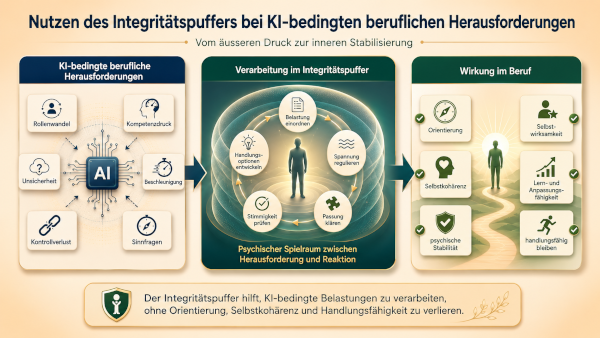
This page explores how people experience AI-driven change at work: as a threat, as unsettling, or as a challenge that can be shaped. At the centre is the question of how the integrity buffer can help us to understand technological change not only in functional terms, but also psychologically and in relation to identity. This brings professional integrity into focus alongside further training. Ultimately, it is this that determines whether I experience myself as affected by AI or challenged by it.
I: AI as a professional mirror
The real question is not only: What is AI doing to my job? It is also: What is this change doing to my sense of myself as a professional?
Many people now wonder whether artificial intelligence will change, devalue or partly replace their work. The question is understandable, but it remains incomplete if it is answered only technically or in terms of the labour market.
From a career counselling perspective, AI also acts as a mirror for our work. It makes visible which elements of a role can be automated, which skills are coming under pressure, and which personal strengths, experiences and attitudes still support us. AI thus becomes not only an issue of further training, but also a question of professional identity.
This is precisely where the integrity buffer comes in. It helps clarify whether, in the midst of AI-driven change, I experience myself primarily as affected – or as challenged.
II: The illusion of clear-cut answers
Objective change and subjective experience do not neatly overlap.
Public debate often suggests that we could draw a clear line: some occupations are affected by AI, others are not. This view is too simple. Two people in the same role can experience the very same technological change in completely different ways.
One person experiences AI as a threat: what previously conveyed security, a sense of competence and professional recognition suddenly seems to lose its value. Another experiences the same development as a stimulus: they discover new tools, new forms of expression or new types of service.
This is nothing new. Earlier technological upheavals already showed that change does not only act on people from the outside; it is also always processed inwardly. Those who were able to develop their role more strongly towards advising, relating or problem-solving often experienced the same change more as an invitation to reposition themselves.
What is new today, however, is that work long regarded as typically human, highly skilled or academic is also coming under pressure: writing, analysing, structuring, translating, pre-sorting, advising or preparing decisions. For this reason, the question of further training alone is no longer enough. It is also about professional integrity: what remains my own contribution when AI takes over part of my previous tasks?
III: The integrity buffer as an inner space for reflection
The integrity buffer protects us from two one-sided responses: blindly rushing to keep up, and stubbornly clinging to the old.
The integrity buffer refers to the inner space in which a person can perceive, examine and process change without immediately falling into either adaptation or resistance. It is a psychological in-between space, located between external demands and inner needs for security, autonomy and coherence.
In this space, decisions are not taken straight away; the first step is to make sense of things: What feels threatening? What feels challenging? What still fits? What needs to be rethought? In the context of AI, this buffer becomes particularly important, because technological change often also touches professional self-esteem.
A robust integrity buffer focuses our attention on three aspects: perceiving change realistically, taking our own sense of being affected seriously, and looking for developmental steps that are not only useful but also feel right.
Two typical patterns of experience
When AI leaves me feeling affected
Change then appears primarily as pressure. Often it is not only a task that is at stake, but also part of my professional self-image.
- What I am good at seems to lose its value.
- I feel I am becoming replaceable.
- I see myself as too old or not technical enough.
- I would have to adapt so much that I would no longer recognise myself.
When AI challenges me
Alongside uncertainty, curiosity also emerges. AI appears not only as an intrusion, but as an opportunity to further develop my professional profile.
- I need to learn more, but I can see possibilities.
- I can present my knowledge in new ways.
- Something new – perhaps even a new service – could grow out of this.
- I can change without losing myself.
From a career counselling perspective, feeling affected is first about stabilisation and taking stock. Which skills will remain reliable? Which experiences can be reinterpreted? Which tasks truly belong to my professional identity – and which routines might I allow to fall away?
When I feel challenged, by contrast, profile development moves more to the fore. Which experiences become more valuable through AI? Which new combinations emerge from expertise, life experience and digital tools? Where might I experiment without sacrificing my integrity?
IV: The central career question
Further training answers the question: What do I need to be able to do next? Career counselling goes on to ask: What truly suits me now, under changed conditions?
The AI upheaval tempts us to ask the wrong leading question: Can AI take over my work? This question matters, but it is too narrow. It focuses mainly on the function – not on the person.
A broader career counselling question would be: What further professional development could emerge – and lead to a renewed sense of coherence – if AI changes my current role profile?
This reframes our view. The focus is no longer only on adapting to the labour market, but on fit: between demands and abilities, between possibilities and life circumstances, between professional role and personal integrity.
A short self-check
How am I currently experiencing AI-driven change?
The following questions are no substitute for individual counselling, but they can prompt an initial process of inner clarification.
I tend to experience myself as affected by AI when …
- I mainly feel loss, pressure or a sense of being replaceable;
- I can hardly see which of my skills still count;
- I have the impression that I must adapt in ways that go against my values;
- I perceive very little room for manoeuvre;
- I experience the pace of change as a threat to my professional identity.
I tend to experience myself as challenged by AI when …
- I feel uncertainty, but also curiosity;
- I can see that my experience can be combined with AI;
- I am keen to try out new roles, services or ways of working;
- I want to change without giving up my professional identity;
- I see AI as an invitation to shape my profile more consciously.
It is important to remember that “affected” and “challenged” are not fixed personality types. They are states that can change. Someone may initially feel affected and later discover within this a challenge that can be shaped. Conversely, initial enthusiasm can fade if change is possible in principle, but no longer feels inwardly coherent.
V: From feeling affected to shaping a challenge
Remaining true to yourself in the AI upheaval does not mean staying as you are. It means changing in such a way that your professional development remains sustainable, meaningful and personally responsible.
The integrity buffer helps us to see the AI upheaval as more than a technical problem. It highlights what is psychologically at stake: self-worth, meaning, fit, belonging and the experience of being effective.
At the same time, it opens up an inner space for trying things out. Here we can explore which developmental steps are not only functionally sensible but also personally sustainable.
At this point, it is worth recalling Bertolt Brecht’s Mr Keuner stories. When someone says to Mr Keuner that he has not changed at all, he starts and turns pale. This small scene contains an important insight: remaining unchanged is not automatically a sign of staying true to oneself. It can also mean that development has failed to occur.
The integrity buffer therefore helps us distinguish between mere adaptation and a living fidelity to ourselves. It supports us in neither refusing development nor idealising it uncritically, but in shaping it so that it fits our own person and life situation.
What follows from this
AI does not only alter job profiles. It often also touches the question of how people experience their competence, their value and their professional future. It is therefore not enough to treat AI-driven change solely as a question of qualifications. We also need to look at fit, coherence and inner sustainability.
This is precisely where the strength of the integrity buffer lies: it helps us to take feelings of being affected seriously without slipping into helplessness. And it helps us to embrace challenge without too quickly submitting to outside expectations. Thus the question “Am I affected by AI?” becomes a broader one: How can I respond to this change in such a way that my professional development continues to fit who I am?
References
- International Labour Organization. (2025). Generative AI and jobs: A 2025 update.
- OECD / Green, A. (2024). Artificial intelligence and the changing demand for skills in the labour market. OECD Artificial Intelligence Papers.
- World Economic Forum. (2025). The Future of Jobs Report 2025.
- HR Today. (2024). What does AI mean for staff development?